
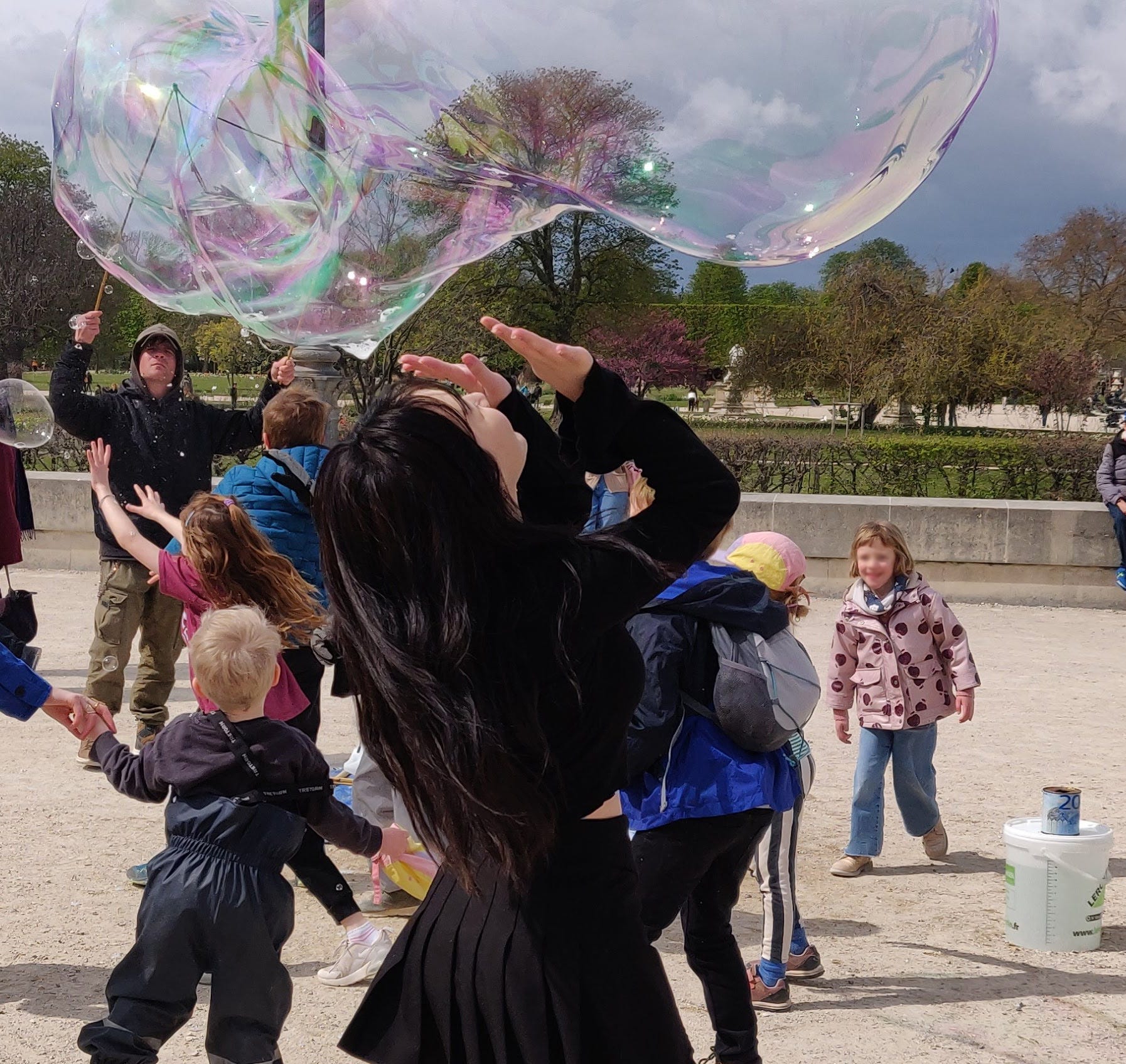
Paris – the spontaneous joy of soap bubbles
It is late afternoon, early in April. We depart with the night train from Sweden amidst snow-covered fields and fir trees. Twenty-two hours later we are greeted by the sun and warmth in Paris.
We are two families traveling together. Four adults and four kids, aged four to six. The plan is to stay two days in Paris and then continue to Lyon. We spend the first full day in Paris in walking mode. We stay on the north side of Seine. There is a big demonstration planned on the other side that we would like to avoid. The Eiffel Tower can be seen in the distance and we point towards it with excitement to show the kids. They are not particularly impressed. They are, however, very excited when we reach Louvren. It is not the building that have peaked their interest. It’s the Bubble man. A young man is earning some money by making gigantic soap bubbles for the tourists. We spend a long time there, eating ice cream and watching the soap bubbles. Our children join a big crowd of kids, running after the bubbles while trying to catch them before they hit the ground. Eyes glimmering of excitement.
It’s evening and we are back in our apartment again. My clock have registered more than fifteen thousand steps. Even our youngest have walked most of the day as well. I am always amazed at their ability to walk long stretches, as long as the route and pace is flexible. And as long as their bellies are full. We are planning our next day in Paris where the main event is to visit the Eiffel Tower. Suddenly my wife exclaims:
“All the trains for Lyon tomorrow are fully booked!”
After a pause, she continues:
“Wait, there’s one train that doesn’t require booking – but it departs at seven’o’clock in the morning.”
Long story short, we decide to save the Eiffel Tower for another time and make for an early night.
The taxi drops us off at Gare de Garcy the next morning. The man at the help desk confirms that our Interrail is valid on the train. He ends by saying:
“But you have to fight for a seat.”
We fight, and we prevail. (It is a rather peaceful fight, we gently ask a passenger if we could change seats.)
Lyon – exploring the city between the two hills
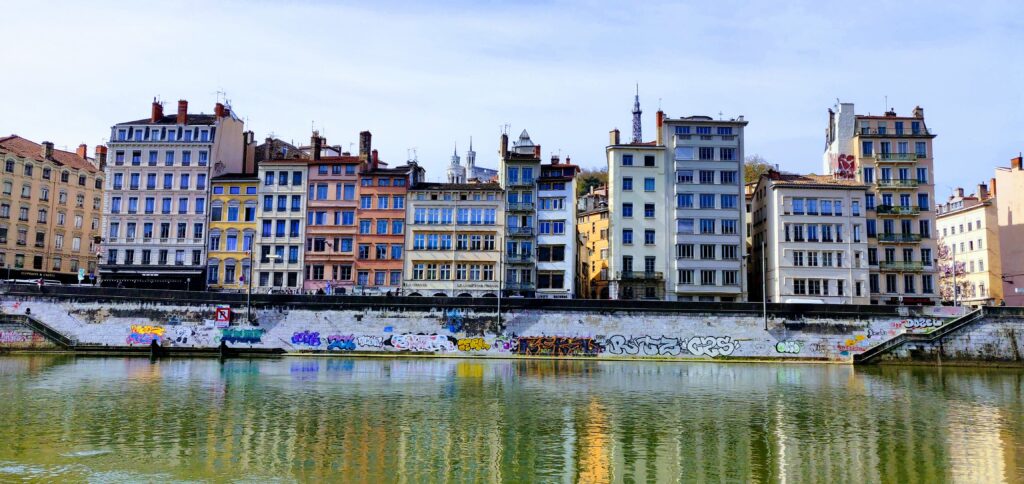
We stay at Pilo Hotel, situated at walking distance to the three notable historical districts of Lyon: Croix-Rousse, Vieux Lyon and Fourvière. These districs are all part of the “Historic Site of Lyon” – an UNESCO World Heritage. We know we want to explore these districts. Apart from that we do not have any fixed plans for our stay in Lyon.
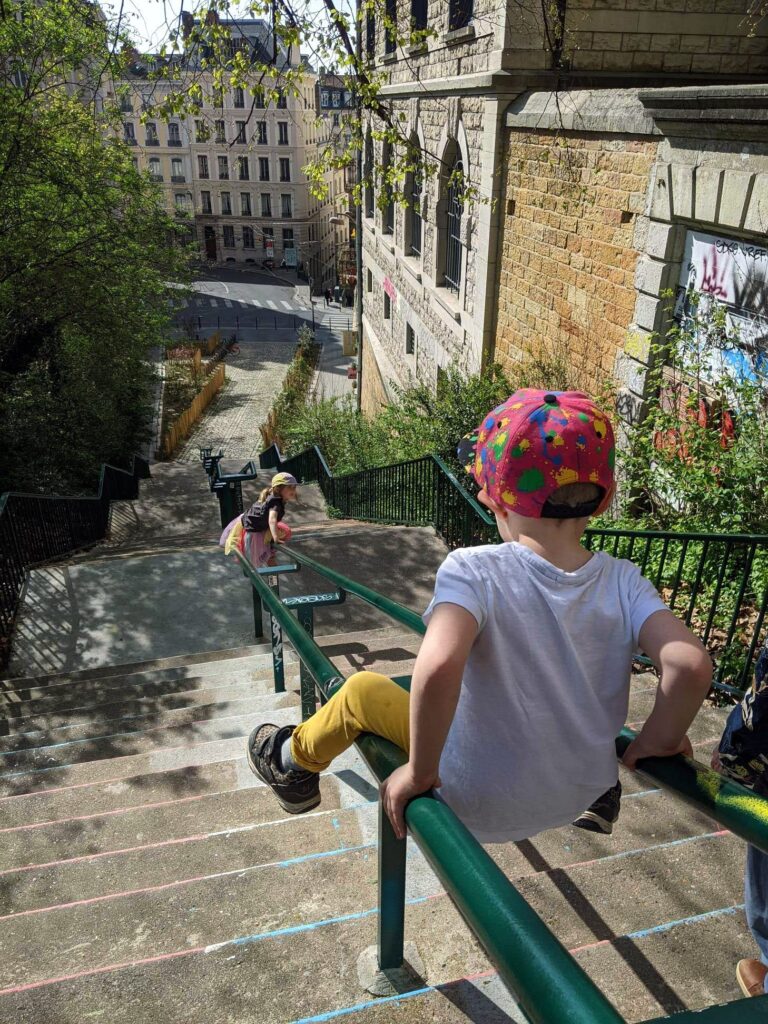
Each stair is an opportunity for play
As we go out to explore our new surroundings, the kids immediately find opportunities to use the city as a playground. The rails along the steps down the hills of Croix-Rousse turns out to be perfect for sliding. The joys of a hilly city.
Coke is the best motivation for learning French
One day we find ourselves at a small creperie along a quiet backstreet in Croix-Rousse. There is a sign on the door that said “Fermé”. We are not sure what it means. The door is open so we go inside and order some crepes.
The two six-year-olds want to sit by themselves at the bar counter, where they can watch the food being prepared. After a while they ask us if they can get a Coca cola. We tell them that they can have one if the manage to order one by themselves. We tell them how to say “s’il vous plait”. They go back to the bar counter and we can hear them whisper to each other, practicing and discussing what to tell the man behind the counter. Finally, we hear them speak out loud:
“S’il vous plait, coca cola.”
After a short while they come over to us with one coke each. Triumphant smiles.
Even us adults learn some French that day. When we finally google “fermé” we learn what it means – closed.
The kids decide where to go next
Last day in Lyon. We ask what the kids want to do.
“Go up and down the hill with the railway.”
There is a funicular, a cable railway along a steep slope, going up to the Fourvière hilltop. The line, which is about 400 meters long with a 30% incline, was opened in 1900 and renovated in 1970.
We walk to the station at Saint-Jean, taking several stops along the way to play, shop and eat. The kids wait eagerly at the platform as the funicular car approaches. There is a sudden cry of panic. Our six-year-old have dropped her pink play-phone down on the rail tracks. She has an outburst of anxiety and is crying. We manage to calm her somewhat and then ask the railway driver to help us fetch the phone. He asks us to wait and walks away. Then follows some tense minutes of waiting. Perfect opportunity to practice the art of staying calm, when faced with hardship and uncertainty. Finally, another man approaches, climbs down on the track to fetch the phone and hands it over to the young owner. She is very relieved.
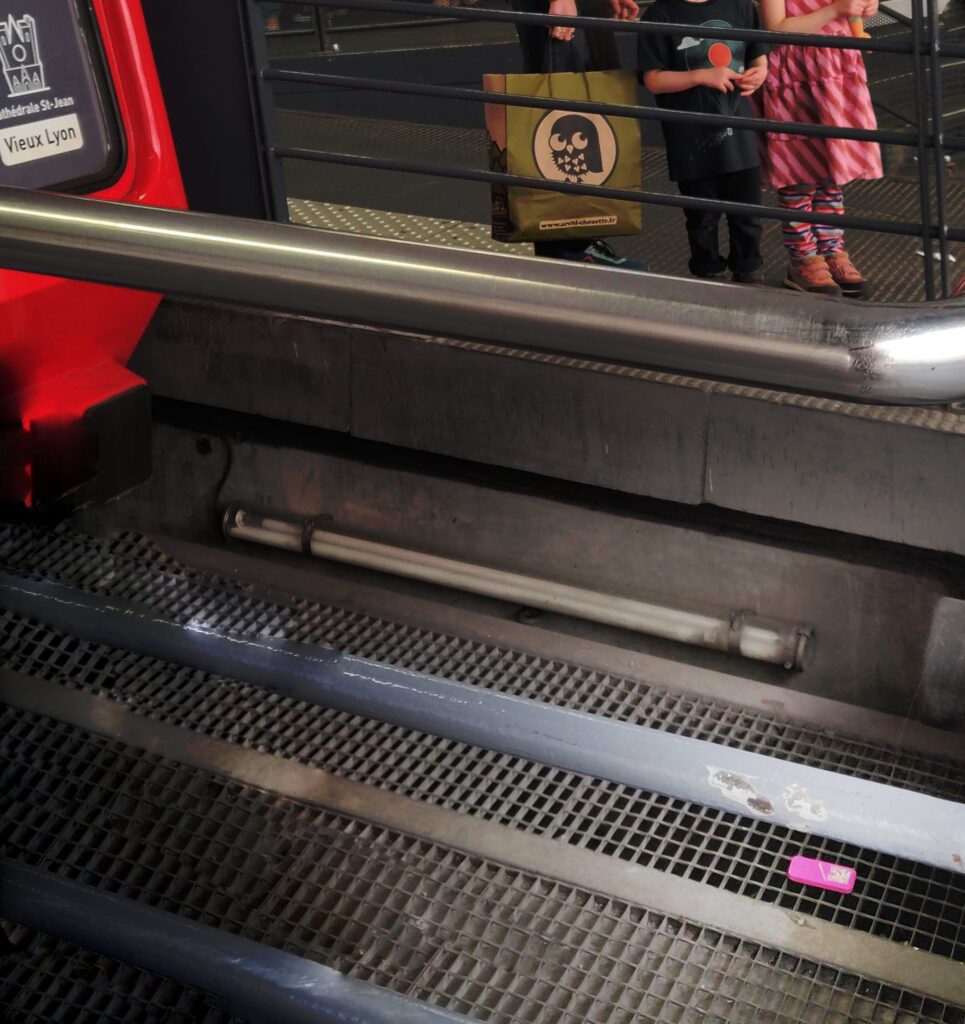
The continued trip with the funicular railway is very enjoyable. The kids sit in the front and watch the car being pulling by the cable along the steep incline in the dimly lit tunnel. Intense focus.
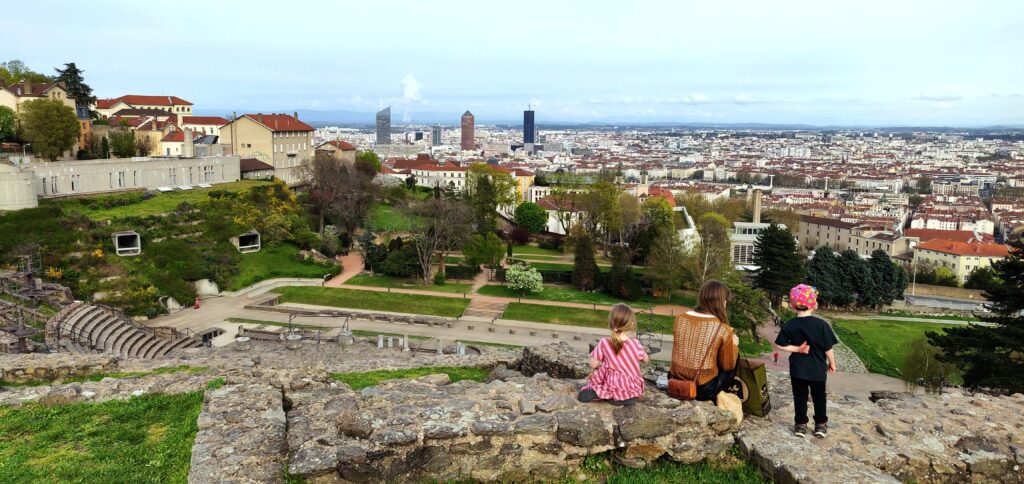
We walk to the ancient Roman theater at Fourvière. We explore the ruins together. Trying to guess the original function of the different tunnels, rooms and walls. The kids want to climb the remnants of the walls behind the cavea. We find a beautiful spot with remarkable views towards the city center of Lyon. The mountains visible in the distance – a shimmering, blue backdrop to the mosaic of white facades and orange brick roofs. I ask the four-year-old to sit down, even though the wall he stands on is not really that high. He respons:
“If I stand up I can see farther. I can even see the mountains.”
He is right, of course. He remains standing. We look toward the mountains together.
The 5 lessons from this trip – and for the next
Choose destinations based on the World heritage sites
Lots of spectacular views and historical settings to explore. Medieval road networks is a nightmare for urban planners, trying to optimize traffic flows. But they are very pleasant to explore as a tourist. See the full list at UNESCO World Heritage List.
Stay in locations where you can mostly move by foot
One part of this is the actual distance to amenities and activities. The other part is the walkability of the area. Google Maps works great for an initial assessment.
Only plan ahead the bare minimum that you need to be able to feel safe and relaxed
For me that usually means to book stay for all nights. I put more effort into understanding the surrounding area and not that much into the actual hotel or apartment. I might write down a few activities that seems interesting, but not much more than that. Activities that require pre-booking for a specific time is a big no-no. The loss of flexibility and spontaneity is not worth it.
Make room for play
Kids find meaning in activities through play (this is true for adults as well, the only difference is that we don’t usually call the games we play as ‘playing’ – we call it ‘working’, ‘exercising’ or ‘dating’). This is essential for an enjoyable trip with our kids. We try to redefine the paths we have to walk with a mindset of playing. Run as fast as you can to the next lamp post. Pause for five minutes to let the kids watch a boat pass by. Go back up the same stairs for the fifth time, to let the kids slide down the rails for one last (really?) time. If the route is difficult to redefine (2 km along a monotonous road), try to adjust the route to a more play-friendly one. Try the longer route along the water instead.
I have to remind me of this constantly. Otherwise it is easy for me to get stuck in an “effective” mindset, narrowly striving to reach the destination as fast as possible. In the end we might have reached the destination ten minutes earlier. But what have I really achieved? Nothing. The kids are angry. I feel miserable for having pushed them too hard. There is a need to push through sometimes – to catch a train or for some other reason. But it is certainly not an “effective” method for creating an enjoyable family holiday.
The ordinary activities brings meaning – if you allow for it
It is often the “small” and spontaneous experiences that turn out to be the most significant and memorable. These things can not be planned for in advance. Your task is to take care of the basics and then leave lots of room in your schedule. The kids will provide for spontaneity. Together you will find meaning – if you allow for it.