After a few weeks of testing I now know more about how the latest bigger changes plays.
This is what works well:
- The fixed, more conventional, game structure with four seasons each with a fixed number of rounds. There’s a reason this structure is used in so many games – it works. Sometimes I miss my old Snowfall cards, but the predictability with the new structure is clearly better for the game.
- Separate the fight mechanic from the income generation mechanic, by replacing the energy territory dice. Now I can increase the incentives for players to fight each other without having to balance it against the harm that a loss will cause to a player’s engine building. Fights can still harm players a little bit and there’s competition for a scarce asset. I like this aspect of the fight mechanic. But you can’t hurt a players main energy generation engine.
- Less constraints. Bigger burrow and no limit to the number of Items.
- Temple is not a territory where you can physically move into with your hamster.
These are the aspects that needs more work:
- Refine the Stance mechanic. I want to find a more elegant mechanic that fulfill these requirements:
- Quick overview for the player of all available main actions.
- One turn = Play one Stance card. This is a simple rule I want to keep on to if possible. It also makes it very convenient to use the played Stance cards to track the number of turns players have performed during the current round.
- Should be clear for the player if you by choosing one action then also cast aside another action.
- Streamline the different types of actions. Currently there are main actions, extra actions, boost actions, the “free” conversion actions and the Boots action.
- Integrate the extra actions more into the core of the game.
- Make it possible to specialize by making certain actions more powerful etc. Allow customization of the stances during the game.
- Refine the income generation mechanics. The game tells the players two different, and somewhat inconsistent things, about the burrow: 1) It is important to get Food into your Burrow, since this is how you get points for your Food. 2) You will hurt your energy generation when you place a Food into Burrow, so maybe you should wait.
I have seen this as an interesting element in the game that forces players to think about the timing of removing Food from your Pouch. The problem is that the engine building part of the game doesn’t have that sweet feeling of getting more and more powerful. - Let the Food in the Burrow be a vital part of the Set Collection mechanics.
- Currently the players feel that they must get one recipe and rise in the Temple when they play the Rise stance. The recipes are so good and there are only one opportunity (or max two if you copy the Rise stance once as well) opportunity to get them. Would be better if the Temple were one viable strategy to pursue that will offer great rewards for the player that persist in it, but you should not feel forced to do it once per round. In addition, the Set Collection requirement for Food cards in the Pouch is difficult to meet if you want to quickly place Food in the Burrow.
- The Objectives are fun but they need more work to function properly. It would probably be best if they work similar to the round scoring tiles in Gaia Project (and many other games…). During the whole round, or at the end of the round, each player gains a number of points for a specific action/object in the game. But I don’t want to introduce the points tracker again just to allow this new mechanic.
Change #1 – Refine the Stances
I finally found a mechanic that fulfill all my requirements for the Stances! I believe it also creates a much more unique experience with action mechanics that are really tailored to Hamster Valley.
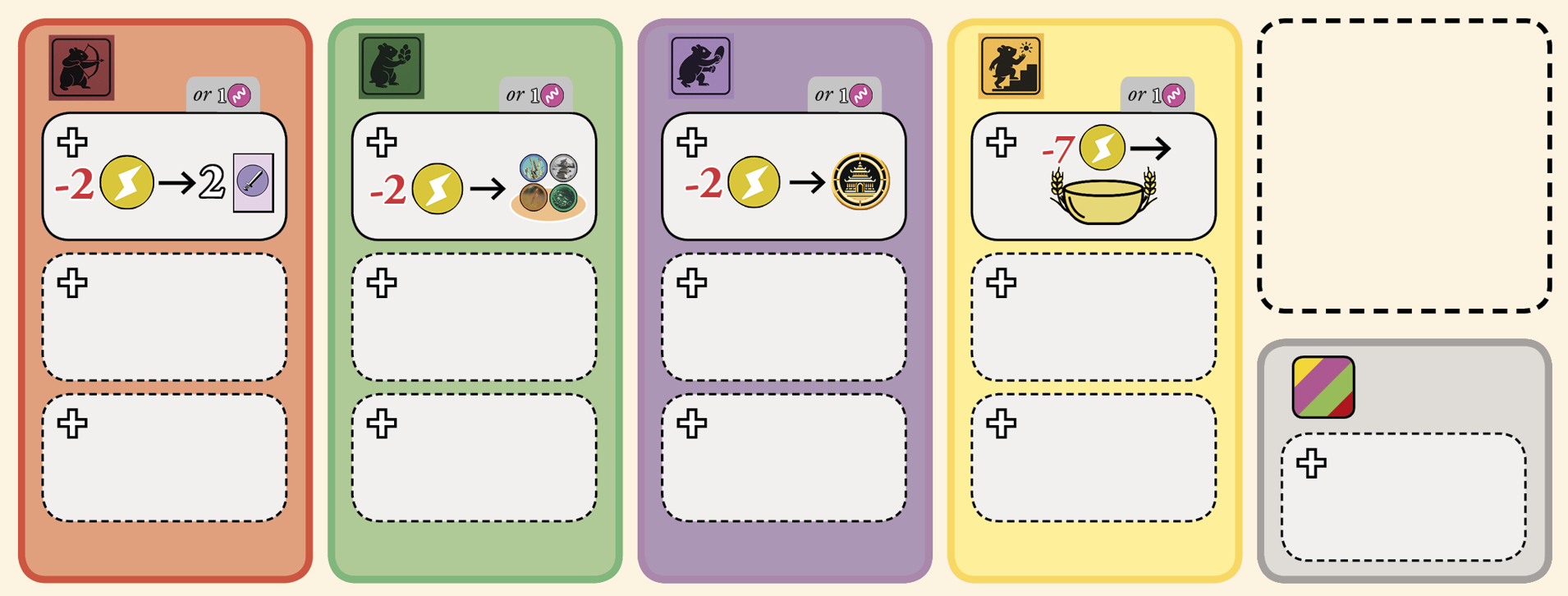
I have introduced a Stance Board with the four stances Hunt, Gather, Snatch and Rise. Each stance have one unique pre-printed extra action that may also be performed when you play an action card with that stance. You may gain 1 Protein, instead of performing the pre-printed extra action.
This board allows me to reduce the Action cards to just the basics: one main action and a specified Stance. There are four cards that must be played with a specific Stance. The Gain Food action can be played in any stance. There is also a Copy action card that allows you to copy the effect and stance of any of the other Action cards (played or in hand).
You keep the Action cards on hand and choose one to play each turn. A round (season) ends when each player has played five stance cards.
The Stance board is also where you collect the extra action tiles that you can gain during the game. Each new extra action tile is placed in one of the allocated slots under one of the Stances. The extra action can then be used once each round when you perform that particular stance. This allows for an interesting customization of the Stances. This is further enhanced by the Items that each will boost one particular stance, e.g. by giving you +2 energy each time you perform the Gather stance.
Extra actions can be gained in a few different places. Each player starts with two tiles that can be used once each to gain a new extra action. This costs 6 energy or discard 2 material or discard 4 fight cards. These are other ways to gain extra actions: Activate your hamster’s special ability to gain a unique extra action tile; Gain one specific recipe; Win over the mid-level Temple cat; Gain a specific Item. Usually you could manage to get one or two extra action tiles during the first season and another one or two during the next season.
Finally, I have removed the Boots card. The card was often confused with the Stance cards. I have felt for quite some time that the Move action would be better to have printed on the player mat. Similar to the conversion action (one protein -> 2 energy). The reason I have hesitated is that the Move action could only be performed once per turn, while the conversion action can be performed any number of times. I have now decided that the Move action should always cost 1 Protein (before it cost 1 energy to move one space and 1 energy and 1 protein to move two spaces). This allows the action to be used any number of times, to be consistent with the conversion action. If you want to move two spaces you simply do it twice for a total cost of 2 Protein. This will slightly increase the amount of Protein that the players need. I have solved this by allowing the pre-printed extra actions to be used to gain 1 protein and also by increasing the starting Protein.

The new Stance board with a pre-printed extra action for each stance and slots for more extra actions below.

The new Action cards. Four of them must be played in the specified Stance (the color). The Gain Food action may be played in any Stance. There is also a Copy action that copy the effect (and Stance) of any other card.

The extra action tiles that can be gained during the game and placed on your Stance board.
Change #2 – Refine The Income Generation Mechanic
Now Food cards in Burrow will give you income at the start of the turn, in addition to the income from Food in your Pouch. You will get +energy for each different type of Food you have in each Burrow slot. If you fill one slot with four different Food types you will also get +1 Protein as income each turn.
This works well. It is now a viable strategy to place a Food to Burrow already during your first few turns. The energy generation will continue to ramp up during the whole game, giving that satisfying feeling of growth that is vital for a good engine building game.
One drawback is that you now need to look at two different places to calculate your income – the Pouch and the Burrow. However, I think this i manageable. Especially considering that I can now make the Food cards much more simplified. There is also an implicit calculation that is simplified with the new mechanic: To calculate how your income is affected when placing a Food card from Pouch to Burrow. All in all, I actually think the income calculations are quicker and less complex with the new mechanic.


The new income generation mechanic allows for simplified Food cards.
Change #3 – Temple Tweaking
Now you can choose to do two different things with your Temple symbols: 1) Rise to a new level in the Temple, fighting the Cat if needed. 2) Take one of the Temple actions that cost 1 or 2 Temple symbols each. More actions are unlocked the higher up you Rise.
The Temple symbols now functions as a regular resource that can be gained and also used.
The new Stance mechanic allows for more flexibility to choose when to collect recipes. You may do it when choosing the Rise action card. You may also do it when playing the Gain Food card or the Copy Action card.
The recipes still require two specific Food types (randomized during setup). However, the Food types should now be in the Burrow, not in the Pouch. This enhances the set collection mechanism for the Burrow. It also means that you no longer hurt your ability to gain recipes when you place a Food from Pouch to Burrow. On the contrary, it is now an important decision to choose what Food type you place in the Burrow, both for income and for enabling you to get recipes.

The tweaked Temple with new Temple actions.
Revised Design Goals For Hamster Valley
This is also a good opportunity to revise my design goals for the game, to reflect the change towards more of a crunchy mid-weight euro-game, although still with a strong theme and high player interaction.
1. Tension Through Time Pressure (The “Winter Countdown”)
Goal: Create a tight, efficiency-based puzzle.
Implementation: With a fixed 16-round structure, players cannot stall to build a mega-engine. Players must feel the pressure of the approaching Winter, forcing them to prioritize immediate tactical gains versus long-term investments.
2. Interactive Engine Building (No “Multiplayer Solitaire”)
Goal: To ensure that optimizing your engine requires constant situational awareness, rather than just looking at your own player board.
Implementation: Interaction is driven by scarcity and timing across multiple systems:
Territory Tiles: A specialized strategic path for powerful immediate bonuses. Since tiles are limited, players must time their moves to snatch them before rivals do.
The Temple Race: Competition for a limited pool of Sacred Recipes and the unique rewards for defeating the Temple Cat.
Direct Effects: Specific hamster abilities that directly affect opponents.
Result: Success depends on reading the table state and executing tactical strikes to seize opportunities before they disappear.
3. Player-Created Asymmetry
Goal: Allow players to “design” their own playstyle dynamically.
Implementation: Asymmetry isn’t just handed out at the start; it is built. By combining specific Item Cards, collecting Extra Action Tiles to slot into Stances, and unlocking their Hamster’s one unique latent ability, players craft a custom faction (e.g., a Temple Specialist vs. a Territory Warlord) differently in every game.
4. Positive-Sum Conflict
Goal: High aggression without “feel-bad” destruction.
Implementation: Combat dictates ownership of bonuses, not the destruction of them. The loser gets a consolation reward (a free Fight card) and keeps their core card engine intact. This lowers the barrier for entry into combat for Euro-gamers.
5. Hierarchical Scoring (Thematic Focus)
Goal: To maintain winter survival (Food) as the primary objective, supported by strategic multipliers rather than “point salad” equality.
Implementation: Scoring follows a clear hierarchy:
1. Primary Source (Burrow): Collecting sets of Food is the mathematical backbone of victory.
2. Strategic Multipliers (Recipes): Sacred Recipes are the semi-essential secondary tier. They provide combo scoring and unique end-game objectives. While players have flexibility in how many they pursue (2–6), ignoring them entirely makes victory difficult.
3. Tactical Utility (Items & Devotion): Items are primarily tools for combat strength and action efficiency, offering only minimal VP (1–2). Similarly, increasing Devotion Level is an optional race for advantages, not a mandatory requirement for winning.
6. “Crunchy” Strategic Weight
Goal: A satisfying mental puzzle for experienced gamers.
Implementation: Aiming for a “Medium-Heavy” weight (3.0–3.5/5 complexity). The teach time is roughly 15-20 minutes to cover the nuance of Stance mechanics and card interactions. The focus is on the depth of the decision space rather than simple family accessibility.