Category: Designer Diary

  • Hamster Valley Designer Diary #9 โ€“ย Big Changes!

    Hamster Valley Designer Diary #9 โ€“ย Big Changes!

    Two weeks ago I had a playtest and design talk with fellow game designer Gustaf. He’s the designer behind the awesome game Ceres (https://boardgamegeek.com/boardgame/349948/ceres). I got a lot of helpful feedback!

    The main problems I wrote down after the design talk:

    • Reconsider the rules for how the game ends. It is very tricky to get it to work well when the players can choose when to end the game. Can work well if the end-game condition is something that all players always want to get (for example in Dune Imperium the game ends when a player reaches a fixed amount of points – and the value is always tracked on a score tracker). In Hamster Valley there is no such obvious end-game condition. The player with the most cards in Burrow may not have the most total score.
    • The game set constraints on the players that limit their ability to build a great engine. For example, limit of max two Items and max four Food in Burrow.
    • When I move in to the Temple with my hamster I no longer use my Stance cards. It feels like the core game is set on pause. Also means less player interaction within the regular territories.
    • It should probably not be an instant win to reach the top of the Temple. A lack of one single Protein means you lose, when the other player is near the top. This means that the only thing that matters is to get that Protein, which makes most choices during that turn meaningless.
    • It’s a bit weird that the energy is reset each turn, but not all actions cost energy.

    Goals for the Redesign

    Based on the identified problems I set up these goals to describe how the game should be if I succeed with the redesign:

    1. More viable options for the player. Several viable ways to specialize in different parts of the game. Find unique combos that enhance your engine. For example be good at fighting, at collecting recipes in the Temple or gaining many Items.
    2. Make the set collection aspect of gaining Food cards more interesting.
    3. Allow the players to “get the engine going”. Reduce the number of constraints.
    4. Speed up the tempo of the game, while still keeping the simple principle of “one turn – one stance”.
    5. Steer the fighting towards gaining instant bonuses that are gained immediately after winning a fight. This means your engine should not be hurt by losing a fight. The instant bonuses should be big enough to still create incentive to win fights.
    6. Make the length of the game more predictable.
    7. The game complexity is allowed to increase slightly because there will be more choices for the players and more strategic depth. However, I don’t want to add complexity by adding more rules or more components. If I add a new component that adds more rules, then I should remove something else.

    Change #1 – Goodbye Snowfalls, Welcome Season Tracker (plus a fixed game end, season objectives and extra actions)

    In theory I really like the idea of not having to keep track of rounds during the game. You play one turn after another until enough snowfalls appear, or something else happens that ends the game. The problem with the snowfalls are that it makes the game length very uneven from one game to another. And there’s another problem with the end-condition hat kicks in when someone fills their burrow. Situations can arise where the player that can end the game don’t want to. I would have to work really hard to get something similar to function well. So I decided to try a more conventional game structure with four phases, one for each season. The rush to get enough Food before winter arrives will still be there. And actually this new structure may make the rush more intense towards the end.

    A season ends when all players have played all their Stance cards. This creates a simple mechanism to keep track of how long is left of the season. Players can no longer choose to play the same Stance multiple times during a season. However, I have added a new Flexible Stance that is a copy of one of the other Stance cards. Each player will do five turns during each season, except the last Winter season where each player only do one turn before the game ends. This means there will be 16 rounds in total.

    I am also trying out some new objective tiles. One objective is scored at the end of each of the first three seasons. The tile is turned face-down at season end to keep track of the current season. The first objective reward is to choose first among a set of cards with extra actions. I’ve seen the need for extra actions for a while now, but I haven’t found an intuitive place for them until now.

    Added and removed components

    +new season tracker
    +the action cards
    +objective tiles.

    -snowfall cards
    -old action tiles

    Change #2 – Temple Remake

    I’ve had the idea of the Temple to be an arena for epic battles between the hamsters, inspired by games such as King of Tokyo and Blood Rage. However, the rest of Hamster Valley is more and more focused on the engine building part. To find powerful combos between Foods, Items and Recipes. I have reached a point where I have to decide if the game should be mainly a fighting game or an engine building game (a euro game). I now decided to steer it more in the euro game direction. This decision led to two bigger changes: 1) a new Temple mechanism, and 2) rethinking the territory energy dice.

    Let me first explain the Temple remake.

    Now, when you do the Rise stance your hamster miniature no longer move into the Temple. Instead you may move your devotion level up one step, if you fulfill the requirements. You need a certain amount of Temple symbols for each devotion level. Also, the first to move up to a new devotion level also need to defeat the Temple cat.

    A higher devotion level means you have access to more sacred food recipes. The Rise stance allows you to gain one recipe for 5 energy. Each column of recipes have two Food type markers at the bottom. You need to have these Food types in your Pouch to pick a recipe from that column. This adds another layer to the core set collection mechanism with the Food cards.

    This change adds some new components, but it reduces the complexity of the Rise stance and makes the rules for fighting and moving more streamlined.

    Added and removed components

    +new recipe tiles
    +cat tiles
    +food cost randomizer tokens
    +temple symbols tracker
    +temple devotion level markers

    -old recipe graphics (showing both actions and scoring)
    -old cat tile
    -lotus flower tiles

    Change #3 – Goodbye Energy Dice, Welcome Territory Tiles

    Two main problems with the energy dice that I had to tackle: 1) It is too limiting that you must have a Food card for each dice. Does not feel good to also lose a dice when you remove a Food. 2) It hurts your engine (your energy generation) a lot to lose a dice.

    There’s also some additional problems with the energy generation mechanisms I wanted to address: It would be better to not reset energy each turn, since some actions does not cost any energy and energy should therefore function as an ordinary resource. Also, each territory effect could be even more differentiated.

    The first thing I tried was to separate the dice from the Food cards. Four slots for energy dice on the player mat, instead of one slot on each Food card. Then, I added a mechanism to gain an immediate bonus when you win a new dice in a fight. The reward from the dice need to shift towards an immediate bonus, to not hurt the engine building when you lose a dice.

    The next step was when I realized that the dice now barley functioned as dice anymore. The main benefit was rewarded when you gained the dice, not when rolling it. It would be more streamlined to take these changes even further and remove the energy dice completely. So I replaced the dice with tiles instead. This had several benefits: 1) Each territory tile has one unique, clearly differentiated reward that sets it apart from the other territories. 2) The energy generation can be fully concentrated to the Food cards. No risk of forgetting to roll the dice as well, which was easy to miss when the dice were no longer placed on the Food cards.

    When you gain a new Territory tile you will get the rewards on the new tile AND the rewards on all tiles you already have. To increase the incentive to fight even when uncertain of victory I also test a new rule where you will score your old tiles even when you lose the fight.

    So each tile you gain increases the rewards you gain for your next tile. But it also means you spread yourself thin, and the more tiles you have the more difficult it is to keep them. This is handled by having a strength value printed on the slots for Territory tiles on the player mat. When you gain a tile you will cover these symbols, thus reducing your fighting power.

    The Food cards themselves are now the primary way to increase energy production. This is done by combining specific types of Food together.


    Added and removed components

    +territory tiles

    -territory energy dice
    -base energy tile

    Change #4 – New Fight System

    I really liked the feel of the custom energy dice and the tetrahedron strength dice. However, with the new direction towards a more puzzly euro game the energy dice had no place in the game anymore. In addition, the strength dice slots on the Items are removed (more about that later). This led me to try out a new fighting system without dice altogether.

    The new system uses hidden strength values on cards to create tension, instead of the dice. The new fight cards can replace both the strength dice and the sword resource. You can have up to five fight cards on hand and you are allowed to play one card per fight. Some cards allow you to gain a big boost to the strength by using Protein or by discarding fight cards. This allows you to go really hard to win a crucial fight. But it will leave you weaker for the next fight.

    Each Item increases you base Strength by one.

    Added and removed components

    +fighting cards

    -strength dice
    -weapons resource (track and marker)

    Change #5 – New Items (As Many As You Can Get!) That Encourage Specialization

    I have removed the max cap of two Items. Now you can have as many as you can get. You still need to have a specific Food type for each Item. But you no longer need to trash the Food. It’s enough to have the specific Food type in your Pouch. This should speed up the speed of the game quite a bit, since you are not hurting your energy generation when you gain an Item. Also, the Items now give continuous effects that will make various actions cheaper. This further speed up the game and also makes it possible to specialize in different parts of the game. For example, by gathering Items that rewards gaining Fight cards, recipes or Territory tiles.

    The end-game scoring conditions on the old Items have been moved to the recipes instead.

    Added and removed components

    -lotus seed cards

    Change #6 – Bigger Burrow, More Choices For Materials

    This is an important change that will allow players to really get rewarded for building a great energy generation engine. Now you can have as many Food cards as you can get into your Burrow, when it is fully built out.

    Change #7 – New Special Abilities

    This is a small change, compared to the other changes. Before, you could get an extra action tile when you performed your special ability. This extra action is now provided by the extra action cards that are distributed to the players after the first season. Instead, I added a unique weapon token for each special ability. This token is removed to indicate that you have used the special ability. The token is placed for example in a territory or on an opponent’s Food and provides an on-going effect there.

    Added and removed components

    +weapon token

    -extra action tile

  • Hamster Valley Designer Diary #8 – More Incentives To Move And Some Balancing, Finally!

    Hamster Valley Designer Diary #8 – More Incentives To Move And Some Balancing, Finally!

    I arranged a three player playtest a few days ago.

    Here is what worked well:

    • The new Temple mechanics (sacred food) were fun and engaging!
    • It was now possible to recover after you lose a dice. The idea with Food cards that add Strength when not occupied by a dice worked well.
    • Most of the other changes that were implemented earlier. For example: Choose one Stance instead of two. The Boots. Swords. These mechanics feel robust and I will keep them.

    Problems that came up:

    • If several snowfalls appear early it affects the game a lot, and not always in a positive way. It severely reduces the number of available Food cards. It also leads to a surplus of Protein. Most players don’t yet have any Food in Burrow so the Protein from the Snowfalls are given to every player, instead of being a small catch-up mechanic for players that are behind. And then there is always the risk of the game ending too early, in the unlikely case that all four snowfall cards appear early in game.
    • The players felt that it did not matter that much what Territory your hamster stays in.
    • The Temple might be too good compared to roaming the other Territories. I think the main problem is that the Temple gives more of everything. More points. More actions. Cheaper actions. If it gives more of something then maybe it should give less of something else.
    • Lotus Seed might now be too cheap. There is almost no opportunity cost at all to activate it.
    • The Snatch stance were not that useful later in the game. The players got their second Item quite early and most of the time there were no shortage of Protein.

    Now I have a new version (0.49) where I have tried to fix all of the above problems. Here is a walk-through of the changes.

    Change #1 – Fix the Snowfalls

    I’ve felt for some time that the Snowfalls are not working optimal. However, there have been more pressing issues with the game that I have focused on instead. Until now. I’ve made three changes to the Snowfalls:

    1. A simple idea to avoid the Snowfalls from appearing too early in the game is to separate each draw pile into two halfs during setup and shuffle the snowfall card into the lower half. I have resisted this since I want an easy setup. But I now realize that it is really needed and I don’t find any better solution if I want to keep the Snowfalls in the game. The new rule will ensure that at least three Food cards will be drawn from a Food deck before a Snowfall card can appear. This will remove the risk of the outlier game that risks ending way too soon. It also should make Protein a bit more scarce during the early game, while the Snowfalls still provide a small catch-up mechanic during late game for the players that are behind.

    2. The Snowfall card is now tucked under the Food cards, instead of occupying one of the slots for Food cards. It worked thematically that the number of Food cards were reduced when it started snowing, but it were problematic for the overall game experience to severely limit the players’ choices during end-game.

    3. The Snowfall cards now have a unique continuous effect that affect only that Territory. This is mainly to make the territories a bit more unique and to add another variable when deciding what territory to move to. It will also speed up the game a bit during the late game (more resources).

    Change #2 – Balance the Temple (And Provide A New Incentive for Movement)

    I have not changed anything about the core mechanics of the new Temple. It worked well with the recipe actions and also the flowers for gaining end-game points. The Temple also created several exciting fights between our hamsters.

    Temple Blessing

    The biggest change is that I have added a Temple Blessing token. This token is placed in one of the four standard territories by the first hamster to enter the Temple. You can only gain Food and Materials from this Territory through the Temple recipe actions. The Blessing token also makes the Food from this Territory cheaper, for all players. The Blessing token stays in the same territory until another Hamster enters the Temple and decides to move it. It is also possible to move the blessing token by taking one of the Temple actions.

    This new mechanic serves two purposes: 1) It puts a restriction on the choices you can make in the Temple to make it a bit more balanced. 2) It adds a dynamic effect that creates an incentive to move (rewards the players that move into the currently blessed territory).

    Balancing the Temple

    I’ve decided to keep all the actions in Temple, but to make some of the individual actions more expensive and/or less potent. I’ve kept the amount of points you can gain the same, and even slightly reduced the cost to place your flower.

    Now the strengths and weaknesses of the Temple are more balanced:
    +Offers a unique way to score additional points.
    +Actions are quite flexible, offering most of the alternatives of the Stance cards, at least at the highest level.
    +You can do two actions at the first level, which can be very strong.
    +Allows you to control what Territory should be blessed.
    -The actions are generally more expensive, or limited in some other way (Food cards are same cost, but limited to just one territory).
    -You have a high risk of being kicked out, losing an energy dice.
    -You have a high risk of being targeted by someone’s special ability.

    To maximize the potential of the Temple now you both need to have lots of Strength AND lots of energy, which is not easy.

    The balancing I have done:

    1) Removed the +2 energy effect on level 1. This is partly compensated by the new Temple blessing mechanic. When you enter the Temple you both get to choose what Territory to bless (maximizing benefit to you and minimize benefit to other players) and if you take a Food card you immediately get the -1 energy cost reduction.

    2) Reduced the cost to place the level 3 flower to gain points.

    3) The action to gain Food only allow you to gain Food from the blessed territory.

    4) The action to gain Material only allow you to gain Material from the blessed territory. The cost is also increased.

    5) The cost to put a Food to Burrow is increased (from 3 to 4 energy).

    6) The cost to gain an Item is increased.

    Change #3 – Tweaking the Special Abilities To Encourage Movement

    This is a subtle but potentially impactful change. I have changed all effects that affect other players. For these effects the opponent must be in the Temple or in the same Territory as you. This has two effects: 1) It makes movement between Territories more important. Both for defense and for offense. 2) It brings even more heat towards the hamster in the Temple. If it’s too much, I may need to tweak this.

    Change #4 – New Special Abilities Action Tiles And Removed Option To Do Both Stance Actions

    This is a bit of a risky change, because I believe it is important to allow more choices for players that have a high energy production. This makes you feel powerful and it is a very satisfying part of the engine building aspect of the game. However, the ability to do both actions by paying 2 energy makes the Stance cards more complex. It is also an option that can rarely be used in the early stages of the game, while still forcing the players to spend time to think about this option.

    The Action tiles that I added in the last version (0.48) works better because they allows the player to unlock an additional action to use for the later stage of the game, when it is needed the most. The new idea is to tweak these Action tiles to make them more fun and unique and useful.

    Now each player will randomly get one of these five tiles at game start. For power players I could also add some kind of optional draft alternative later on. The tile is placed beside your hamster’s special ability. When you activate the ability you move the tile to its active slot near one of the Item slots on your player mat. When you also get that Item you can start using this unique action, once each turn.
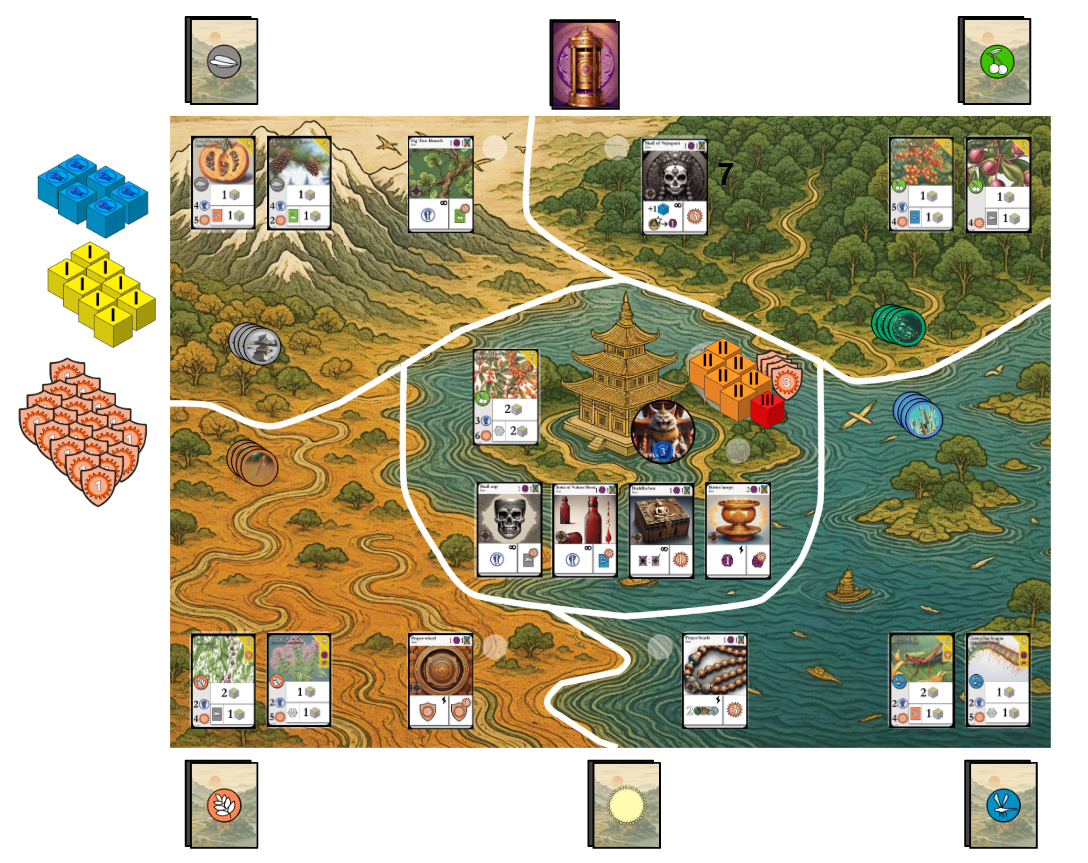
    Hopefully these tiles can now increase the options enough in the late game to allow me to get rid of the double action option on the Stance cards. I also like the idea that it allows for more variation. Players can discover interactions between different tiles and the hamster abilities, thus improving replayability.

    Change #5 – Increase the Cost of the Lotus Seed

    The Lotus Seed now costs 3 energy and 1 protein to activate (previously only 3 energy). A subtle change but I think it will be beneficial in two ways: 1) Makes Items slightly more difficult to get. 2) Makes Protein slightly less abundant.

    Change #6 – Adjustments To the Snatch Stance

    The other changes will make protein more scarce. It will also make it a little bit more difficult to get one and two Items. This in itself will make the value of the Snatch stance to increase. I have also added an option to convert 3 energy to 3 swords, to further reduce the risk of the stance being useless in late game. Maybe this also opens up for some aggressive play styles where you rapidly max out your Swords for an upcoming attack.

    Change # 7 – Small Tweaks

    1) Reduced the starting protein from 2 down to 1 protein.

    2) Changed the effect on the blue energy dice. The move action was useless in many situations. I have changed it to “restore all stance cards”. This effect is still not that powerful, but in most cases it is at least somewhat useful, and at most it is equivalent to gaining 1 protein. It is obviously not as good as the grey dice that give you a protein, so the blue dice still have no blank sides (the grey dice have two blank sides).

    3) The red Cat dice now can only activate Temple actions on level 1. Mainly to avoid AP (analysis paralysis) by reducing the number of choices. But I think it also were a bit too powerful before.

    4) Changed the Rise stance “consolation prize” (gained when losing the fight for the Temple). Before it gave you 1 Sword and also one copy of any other stance action. This meant it was almost always better to try to attack the Temple, even if you had an extremely slim chance of winning the fight. Now you gain 1 Sword and may also take a Food. My goal is that it will still be very tempting to attack the Temple, but not when you have only like 2% chance of winning.

  • Hamster Valley Designer Diary #6 โ€“ It’s Time to Simplify – And Some New Character Concept Art!

    Hamster Valley Designer Diary #6 โ€“ It’s Time to Simplify – And Some New Character Concept Art!

    Overall Goal With This Revision of Hamster Valley

    Lets skip the Hamster special abilities for this playtest.
    -Myself, realizing it will take too long time to explain all the rules for this late night play test

    I arranged a new play test a few days ago. I learned a lot! My most important realization? It’s time to simplify!

    My iterative design processes often cycles through two main phases. First a phase where the focus is to increase the strategic depth of the game and to come up with new interesting decisions for the players. After a while there is a turning point. The added layers of the mechanisms, components and rules add too much confusion. There is also more and more time required to explain the rules for new players. This is peak complexity. Ironically this is often when I myself feel the game is the best. This feeling lasts until I play test the game with new players. I now realize that there is a more elegant and even more enjoyable game hidden beneath all layers of added rules. I just need to carve it out and remove the non-essential parts. The focus now shifts to reducing complexity and simplify the game.
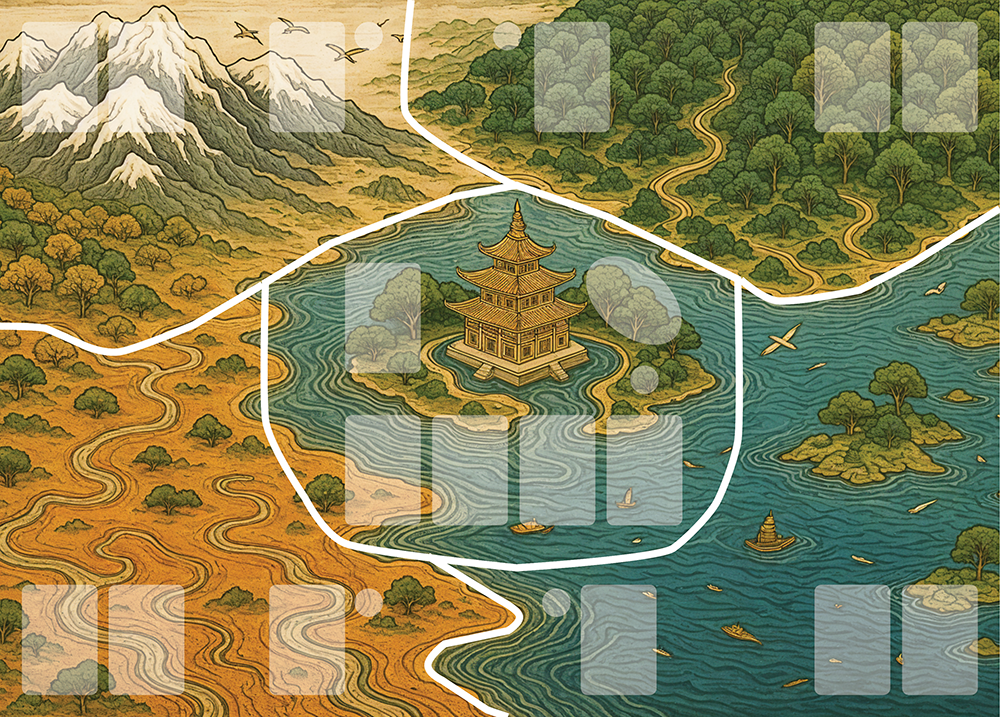
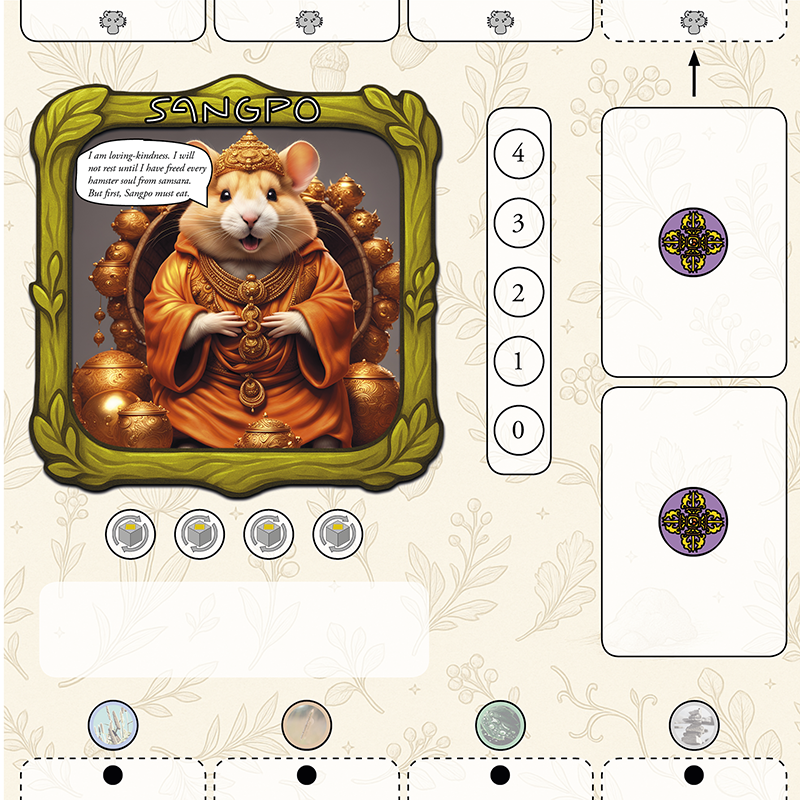
    The challenge is to simplify without losing the strategic depth and flexibility that the previous iterations have added. If I succeed there will be fewer rules and exceptions to learn. Players can focus more on making interesting and impactful decision in the game. Simply put – a more enjoyable game!

    After the most recent play test I identified three areas that were most crucial to simplify:

    • The Stances
    • The Temple and the Cat mechanics
    • The Protein tiles (again!)

    Here’s a walk through of the latest batch of changes with some relevant quotes from the play testers.

    Change #1 – Limit of One Lotus Seed For Each Player

    Lotus Seed is too good!

    Background and problem

    Yes, they were too good. The main idea with them were to make it easier to get Items. This worked quite well and they were regularly used to get Items since they could be used as any Food type. This in itself made the Lotus Seed very powerful. In addition to this they also increased the Protein you could gain (through Protein Combination tiles). They also made several end game scoring Items too powerful.

    This also made the Grasslands dice very good, since you had a 1/6 chance to get a Lotus Seed for free.

    The Lotus Seeds solved the problem they were supposed to solve, but they also added new problems. How could I reimplement the Lotus Seeds in a way that keeps the flexibility they gave while removing the negative effects?

    Solution

    I found a new solution that also help with another issue that I have been struggling with – to make it visually clear that the fourth Pouch slot is locked initially.

    With the new Lotus Seeds there is only one Lotus Seed for each player. During setup the card is placed face down at the fourth Pouch slot, indicating with a lock symbol that this slot is not available. The player may at any time pay a cost to unlock the slot and turn the Lotus Seed face up. This means the player has one special Food that can be used as any Food type. It can be used to get an Item, to place in the Burrow for extra end game scoring or just as a regular Food (albeit with quite weak stats). I hope it still give flexibility with choosing Items while also being more balanced.

    Change #2 – Limit Cat Fighting to the Temple and Remove Temple Actions

    The fleeing Cat pushed me out of the Territory and completely screwed up my strategy.

    Background and problem

    The rules for the Temple and the Temple cat is often the most confusing for new players.

    I like the idea that the Cat flees the Temple when it is defeated and starts to roam around in the other Territories. However, this makes the rules more complex for the Rise stance. It needs to accommodate for two different states – when the Cat is in the Temple and when it’s in another Territory.

    I feel the same with the Temple actions. They work quite well with experienced players. For new players, it instead means one more rule to explain and more symbols on the board to process. Also, I’ve always been annoyed that I need to have a specific action for moving out of the Temple. This action is almost never used but it still needs to be there so you can’t be trapped in the Temple.

    Solution

    The Cat now stays in the Temple. When defeated it goes into hiding mode and can not fight. Later, if the Temple is empty the Cat will appear again to defend the Temple. No more unpleasant surprises where the Cat pushed you out of a territory and forces you to rethink what to do your next turn. This also makes it possible to streamline the Rise stance so it is all about the Temple. And it allows me to make the rules for dice fighting more consistent. See more below.

    I realized that I have added to the Temple actions to the point that they almost replicate all the type of actions that are already on the Stance cards. Gain Food, Gain Item and Place Food in Burrow are all available as Temple actions. Why not just let the player do whatever Stance action they want in the Temple? This is what I decided to try out.

    It requires some minor clarifications of some rules regarding the Stance actions. But I think they are quite intuitive. I have added a “not in Temple” symbol on two actions: Gain Material and Fight for Dice. I also need to clarify in the rulebook that you can gain any Food while in the Temple. I think it is worth it since this allows me to completely get rid of the Temple actions. Fewer symbols and rules to explain for new players. Yay!

    Change #3 – Consistent Dice Fighting Mechanics (Always Fight in the Territory Where the Dice Owner Is)

    Oh, so I need to attack the Cat to get red dice that you own?

    Background and problem

    Some confusion about where you need to fight to gain a specific dice has come up regularly during all the recent iterations of the game. Do you fight in the territory that matches the dice type? Yes, except for the red Cat dice you fight the owner of that dice, which initially is the Cat but later it will be one of the hamsters. This is a bit confusing for new players.

    Solution

    Now, when the Cat stays in the Temple, I saw the chance to also make the Dice fighting more consistent. Now you always fight the dice owner to gain a specific dice. This is true for both the regular Territory dice and for the red Cat dice. As an added bonus, this change also eliminate the need to have the “rush rule” for rushing into fight when you are in an adjacent territory. One less rule and one less choice to make = quicker game play.

    Of course, in the beginning of the game the Territory dice have no owner so then you get them in their respective territory. But I think this is obvious even to new players because the dice are placed in their respective territory, clearly visible on the game board. Lets try it and find out!

    Change #4 – Bye Bye Reroll Tokens, Welcome Swords (and Reroll Tiles)

    Background and problem

    The reroll tokens work okay. They let players reduce the amount of randomness by gathering more tokens. It’s also a way to improve your energy engine. But they don’t really connect with the theme. What does the reroll token represent for the hamsters? Also, the tokens are small and a bit fiddly. They act as a kind of implicit third resource (in addition to energy and protein) but there is no clearly designated place to store them.

    Solution

    Lets try to scrap the reroll tokens. Welcome Swords! This is a new resource that has one purpose – to increase your Strength dice rolls. You may use Swords during a Fight, before you roll the dice. One Sword will add one Strength to your dice value. If you lose a Fight when trying to conquer the Temple you will get one Sword to increase your odds the next time. I have added a third resource tracker for the Swords.

    But how can I improve my Energy dice rolls? I figured I should add some kind of new incentive to get the Items, now that the first Item does not give you an additional Food slot in the Pouch anymore. Welcome Reroll tiles! Each Item will now unlock one permanent reroll. The tiles have a specific space at the player mat. A tile can be used once each turn to reroll an energy dice.

    These are some of the smaller changes this time. It is also the ones that I have put the least thought into. I might very well tweak this further later on. But lets try it out first!

    Change #5 – Bye Bye Protein Tiles (Or “I Killed My Darling”)

    It’s still challenging to get Protein.

    Background and problem

    I really like the idea with the Protein tiles. I think it’s because I see them as a sort of contracts-mechanic. I love games where I get to fulfill contracts to gain some reward. Unfortunately I can’t get it to work in this game. I’ve really tried. So now it’s time to kill my darling.

    Solution

    The solution is to revert back to a version of the previous protein mechanic. The core idea is that combinations of Food cards of different types should give you more protein. The most basic implementation of that idea is to just gain one protein for each Food type in your Pouch. So that is what the new Protein action does. I have put a cap on max 3 Protein. It will still give you a bit more Protein than before, which I think is good for the game pace and balance in the game. I can just tweak it later if it is too much.

    This change means one fewer component (11 protein tiles) and I can also remove one of the bonus actions of the stance cards (important to allow me to implement change #6).

    Change #6 – Limit to One Stance Card Each Turn (And Remake of the Stances)

    You always play two Stance cards, except when playing Rise which is always played by itself. Also, in the Temple you are only allowed to play Rise, and it will cost you a Protein if you have to recall your Stance cards because Rise were already played in a previous turn. But the only thing that really happens is that you Ascend, so you don’t really need to look at the Rise card itself. Instead, look at the separate Temple action guide to see the actions available. There are five Temple actions: Food to Burrow; Gain 1 Heat; Move out of Temple; Look at three top Items and gain one for free; Gain any Food costing up to three energy.
    -Myself, struggling to explain the rules for Stances and the Temple before the changes

    Background and problem

    Every time I explain the rules for Stances I get annoyed because the number of Stance cards to play each turn is not consistent. Several times I have tried to modify the Stances so you always play only one Stance card each turn. I have always failed to implement it in a way that still keeps the flexibility that the new system with Stance cards allowed.

    During the play test the bonus actions worked quite well when they were used. But several of the bonus actions were barely used at all and they were often forgotten.

    The Rise card also cause some confusion because it can both be used to move into the Temple and to another Territory, but only if the Cat is there.

    Solution

    Now I saw an opportunity to finally implement a “one stance”-rule. Three of the four bonus actions were already unnecessary since I had removed three components: the reroll tokens, the Lotus seeds (still there but they can’t be bought from the Supply) and the Protein tiles.

    The main challenge I had to solve had to do with the Move action. Before the changes you could move every third turn, without spending extra Protein to recall your Stance cards. This is already barely enough. I figured I could remove one Stance card and go from five stances to four. But this would still mean you could only Move for free once every fourth turn, if you play only one Stance card each turn. Not flexible enough.

    I have tried before to have a separate Move phase so you could move every turn. But this caused problems with ordering. Players often want to choose if they should move first or do some other action first and then move. I also like the clarity that comes from all actions being visible on the Stance cards. The move action would not be visible if I had a separate Move phase.

    The solution is the new Boots. This is a new type of action card. It is similar to the Stance cards but its an object to separate it from the stances. The Boots can be activated once each turn. The Boots allow you to move one space for free and two spaces for 1 Protein. This is a feature I have considered for a long time to give more flexibility to players, but there have not been enough space on the Stance cards to implement it in an obvious way. You can use the Boots to gain 1 Energy instead, if you don’t want to move. This allowed me to remove the Action that gives you 2 energy.

    Another challenge is to have a distribution of the actions on the Stance cards so that you can always choose an Action that lets you spend your energy. With just one action per turn this would be problematic without any additional mechanics. For example, if I choose to get Protein, what would I use my energy for? The new solution to this have two parts: 1) allow the player to do both actions on the Stance card by paying 2 energy, and 2) Add a free action (printed on the player mat) that converts 2 energy into 1 sword.

    All in all, I now have the same number of cards (4 stances and the Boots) but fewer symbols and rules. Yet there is more flexibility for the player (the ability to do both actions for 2 energy and the Boots which allow you to move more freely or choose to gain extra energy).

    The other changes to the Temple and Cat mechanics also allowed me to simplify the Rise stance. It is now solely about conquering the Temple. Much cleaner and aligns better thematically.

    Lets end with a new quote that covers everything I tried to cover in the quote above, but now with fewer words thanks to the updated rules:

    You always play one Stance card. You may also activate your Boots once each turn. In the Temple you don’t play any Stance, instead you may Ascend once for 1 Protein to gain the rewards. This symbol means you may choose any of the Stance actions, that are valid in the Temple.
    -My future self, happily explaining the simplified rules

    Bonus – New Hamster Concept Art!!

    I’ve also been busy working on some new concept art for the hamsters and the player mats. I’m quite happy with how this turned out. I’m thinking about making a post to describe some workflows I use to create the artwork. Let me know if that’s something you would like to see more about!

    I’ve also asked my 3d-modeller friend to update the hamster miniatures and to create a new Temple cat miniature. My next physical prototype is going to look awesome!

  • Hamster Valley Designer Diary #5 โ€“ More Flexibility For Players

    Hamster Valley Designer Diary #5 โ€“ More Flexibility For Players

    In the beginning of this week I arranged a full-length digital playtest with two other players. They were both completely new to Hamster Valley. I came away with a lot of valuable feedback and insights!

    The Good

    “I want to play again!”

    “Great satisfaction to achieve the dice-bonuses on the Food cards.”

    “I like the look of the game board.”

    “I like the dynamics of combining both dice and cards for my engine building.”

    Most of the mechanisms worked as I have intended and there were a good amount of player interaction. We were fighting for both Territory dice and for control of the Temple. The game took about 90 minutes which is OK with three players when two of us where new to the game. One of the players spontaneously said that he wanted to play again, which is a very good indicator for enjoyment.

    The Bad

    “Felt limited by being last in turn order.”

    “Too difficult to get the first Item.”

    “Felt limited by having to move as the first action. I wanted to grab the Material/Die/Card in my current Territory and then move out.”

    “The Cat were too good when it increased in Strength after two Snowfalls had landed.”

    “Very difficult to get Protein again (after leaving the Temple depleted).”

    To summarize the main problems I noticed during the playtest:

    • Not enough flexibility when choosing and performing actions on the Stances
    • The requirement to have a specific Food type to gain an Item felt too restrictive
    • Game pace a bit too slow – players often struggled to get enough Food cards
    • The main mechanism intended to get Protein wasn’t used at all during the game
    • Some balancing issues with play order, the Temple and the Hamster abilities

    Change #1 – Increase Start Resources & Give Protein As Turn Order Handicap

    It is often crucial to have a good 2-cost Food on the board, when you start with only 2 energy. I have now increased the start energy to 3 energy for all players. This makes the first few turns less reliant on what Food cards happen to be drawn at game start. More generally it also open up for more alternatives in the first few turns.

    All players except the start player will now get extra Protein at game start, instead of reroll tokens. This should be considerable more powerful and will hopefully balance up the first-player advantage. More playtesting will be needed to confirm this.

    These two changes together also increases the game pace a bit, which is a good thing. The playtime often ends up in the high end of the range I want the game to hit (~20-25 min per player).

    Change #2 – Introduce a “Wildcard” Food – Welcome Lotus Seed!

    I have struggled with the mechanism for getting Items. I think the idea that you need to discard a Food card to get an Item adds a lot to the game. However, many times one player might have a significant advantage, depending on the start Territory and what Items are drawn at game start.

    My new idea is to introduce a “wildcard” Food that can be used as any of the other four basic Food types. I call it Lotus Seed. This Food costs 3 energy and can be gained in any Territory through a Bonus Action of the new Roam Stance. There are eight Lotus Seed cards in total, with one of those always available.

    The Lotus Seed cards have several beneficial effects:
    *More flexible to choose what Item to get. Less dependent on what Items are drawn at game start.
    *There will always (at least in the beginning of the game) be a Food to get for max 3 energy. Less dependent on what Food cards are drawn at game start
    *Now possible to get Food cards on two different Stances. Increased game pace.
    *Easier to get the Food type combos needed to use the Protein tiles.

    This is the only new component introduced in this batch if changes. I am always hesitant to introduce new elements and components, but in this case I believe the benefits is enough to motivate it.

    Change #3 – Remake Stances: Remove Action Order & Introduce Bonus Actions

    I have managed to simplify the Stances a great deal in previous changes. Generally the Stance mechanism works well. However, I identified some issues with the Stances:
    *Sometimes too limited by the order the actions had to be performed.
    *ln some situations the Roam stance were quite useless.
    *Need Food cards more often than the regular cycling of Stance cards allow. Especially if you want to use the Protein tiles (since those Actions are on the same Stance card and you have to choose only one). And you must get Protein to be able to cycle faster.

    The updated Stance cards address all these issues I believe. The player is now free to choose what order the actions are performed. The requirement that you have to move first is mostly a remnant from an earlier version where the rules made it necessary for the turn order flow to be logical. That is no longer the case.

    I have also added one Bonus Action on each of the regular Stances. These add a bit of complexity, but it also allowed me to remove two “free actions” so I think it will be manageable. One of the Bonus Actions is to gain a Lotus Seed Food for 3 energy. This give the player two Stance cards for gaining Food.

    Change #4 – Protein Tiles Tweaks

    The main solution to the problem with players not using the Protein tiles is the changes made to the Stance cards, and the introduction of the Lotus Seed cards. I have also tweaked the Protein tiles and they now give more Protein for the 2-type combos. The tiles also stay face-up after use, allowing a player to gain the rewards again on a later turn. There is now a Bonus Action to discard a Protein tile, which allows for some low-intensity player interaction.

    Change #5 – Now You Can Gain Protein In The Temple!

    One of the players expressed that it was difficult to regain Protein once you leave the Temple with zero Protein. I have noticed this myself but I had not decided if it was a problem or not. Now I decided to try to remove the rule that says that you can not gain any Protein in the Temple. One rule less to remember.

    If it turns out that the Temple is too powerful, I can pull other levers to balance this. For example the Strength penalty when staying in the Temple or tweaking the Temple rewards.

    Change #6 – New Strength Dice – Welcome D4 Tetrahedron!

    This change is not really issues that surfaced during the playtest. It is something I have planned to do for a long time.

    I see several benefits with using D4 instead of D6 for the Strength dice:
    *Clear visual difference between energy dice slots and strength dice slots on the cards and other components. Rectangle vs. triangle.
    *Standard dice values, 1-4. Players often asked for the distribution of numbers on the custom D6 Strength dice. I have not found an obvious place to put that info on the game board or any other place. Now I don’t need to find any place at all, since I don’t need that info anymore. The best place for info is nowhere – make it so obvious that you don’t need the info at all.
    *Can use purple standard D4 dice. Fewer custom dice to manufacture.
    *The D4 looks sharp and dangerous – perfect for the dice that are involved in fighting!

    I had to tweak the Strength values for the Cat and the Temple Strength penalty. The Strength value for the cat is now 5 Strength and it increases with 2 Strength for each snowfall. This is actually a reduction in relative strength for the Cat, in line with the comments during the playtest.

  • Hamster Valley Designer Diary #4 – More interesting choices = More fun!

    Hamster Valley Designer Diary #4 – More interesting choices = More fun!

    The feedback during LinCon and the changes afterwards led to a better game. In particular, I really liked the new mechanic for the energy engine where each Food card can hold one energy die. However I still had a few critical problems left to deal with:

    • The Temple is fun in theory but not when actually playing the game. The mechanics does not feel unique and is not tied thematically to the idea of a temple. There is no strong incentive to try to keep control of the Temple.
    • Too easy to generate a lot of energy.
    • The actions on each Stance is difficult to understand for new players. The text and icons is also too small and unclear.
    • There is not that much fighting going on, even though I want it to be a vital part of the game experience.
    • The Food cards are quite similar. They are not enough differentiated when it comes to cost and benefits. I want the choices in the game to be more affected by what Items you own.
    • There is only one way to collect Materials (choose the Gather stance). This puts a limit on how fast the leading player can fill their Burrow and end the game. It is not enough to just generate a lot of energy, you also need to get the Materials. This is a good thing. However, it also forces players into a very limited set of choices if they want to fill their Burrow. You must choose Gather, nothing else matters. This makes gameplay less interesting.

    I have worked intensely to address all of these problems. I have made some great progress in the past weeks. Now I want to share some of the biggest changes and the reasoning behind them.

    Change #1: Remove the Starting Energy Die

    Hamster Valley Prototype Start Food

    This change seems so obvious in hindsight. It solves both the problem with too much energy and also encourages more fighting, since there is now fewer dice available. The starting Food card can still hold an energy die of any color, but you need to fight to get one.

    Change #2: Simplified Stance Cards

    I have added five Stance cards, replacing the Stance “selector” on the player mat. I am very happy with the result. It allows for much bigger symbols and more clear layout. It is also easier for new player to understand. At the same time, the main benefit of the stance mechanic is still there – the cards offer a visual overview of all actions that are available to you and they help connect the actions to the theme.

    You play two Stance cards each turn and choose one action on each card. If you choose the Rise card you only play that card. You must play all cards before you can return them to your hand and play them again. It takes three turns to cycle all your Stance cards. You may use Protein to return the cards to hand before you have played all.

    Change #3: No Cost to Defend a Die

    Another small change to encourage more fights between the players’ hamsters. If it costs nothing to defend then you might as well try. The attacking player wins ties, as an incentive to actually attack.

    Change #4: More Ways to Collect Materials

    Now you can get materials also as an instant effect on some Food and Items. You can also get it if you stay a few turns in the Temple. The Materials is still a necessary requirement to be able to expand your Burrow, separate from your energy generation, but there is now some flexibility in how you get them.

    Change #6: More Unique Food and Items

    Item costs now range from 2-7 energy (2-5 energy before). Each Item also have a unique end game scoring criteria.

    Food costs now range from 2-6 energy (2-5 energy before) and Heat values range from 2-7 (3-5 before). There are also more instant one-time effects that activates when you get a Food. There are some Food cards that will give you a huge +2 energy bonus if you also collect a specific energy die. This bonus is a great incentive to chase a specific die which adds strategic depth.

    Change #7: New Temple Mechanic

    The Temple now offers special Temple Actions. These are only available if you manage to defeat the Temple cat. When defeated, the cat flees and start roaming the other territories. You may choose to stay in the Temple for as many turns as possible, until you run out of Protein or until you get kicked out by someone else.

    For each turn you stay you will ascend one step closer to Enlightenment. Each step give greater rewards but you will also get exhausted and lose Strength, making it easier to defeat you. There are some extra spicy bonuses available for the first player to enter the Temple. This creates a mini-race to defeat the cat first, in addition to the bigger over-arching race to collect Food and Heat before winter arrives.

    It is very hard to reach all the way to Enlightenment, but if you do the reward is the greatest possible – you win immediately! This brings a unique and thematic mechanic to the Temple that I really enjoy. It also helps create the tension and feeling of urgency that is an important design goal for this game.

    Change #8: Energy Can’t Be Stored

    I’ve changed my mind several times during the years of development of the game. Should you be able to store energy from one turn to the next? Or not? Now I have decided that it is best for energy to be transient. For me, it works better thematically for energy to fade quickly after it has been generated. It also makes it a bit easier to control the pacing of the engine building aspect.

    Change #9: Remove Heat Tokens

    In the beginning of the game’s development Heat/Victory points were distributed only at game-end. Over time, I added Heat tokens that could be obtained during the game. Mainly as a way to create incentives for the players to choose certain actions to control the game pace or to balance the value of the different actions. I also think it feels “clean” somehow to not have a Heat scoring track. The cards and components itself will tell you how much Heat you have.

    And after a while, I also added the possibility to convert Heat tokens to energy. This was a convenient way to give players more options when they might be short just one energy for a very valuable action. However, it was never an ideal solution: 1) It is difficult to decide how many tokens are “enough” for a game. Some strategies accumulated a lot of tokens. I wanted to allow those kind of strategies, but it would require a lot of tokens = a lot of cardboard components. 2) It only made sense to convent Heat to Energy for very valuable actions. Often it didn’t even make sense to do this to place a fourth Food in the Burrow.

    Finally I gave in and added a scoring track. Now that I have it I actually think it will be kind of nice with a the scoring track as a frame around the game board. I get rid of a lot of cardboard components. Also, now you can convert Protein to Energy instead, which works better both thematically and for the gameplay.

    Change #10: Bye Bye Focus, Welcome Protein!

    Focus is now called Protein instead. There are several reasons for the change: 1) I wanted a more interesting and strategic mechanism for gaining Focus (now Protein). I came up with a mechanism with protein combination tiles. Different combinations of Food types will give you Protein and some Heat. This mechanic works well thematically for Protein.Not so well with Focus. Protein is made up of amino acids. High-grade protein requires several different amino acids from different food sources. It is reasonable to imagine that these combinations also may change depending on the season. 2) It works well thematically to convert Protein to Energy. It is also easy to accept that energy is transient while Protein is something you can store from one turn to the next. 3) I needed a clean symbol that is distinct from the other symbols. The Focus symbol were quite easy to confuse with either the Strength or the Heat symbol.

    Summary

    It is a good thing when I manage to improve the gameplay by remove something from the game.

    A good example is the changes to the Temple. The new rules required some new graphics on the game board and a few tokens. At the same time this allowed me to remove a lot of special Temple dice (expensive to produce and takes up a lot of space in the game box), the Shield token and all of the Blessed food cards. The end results is a more unique Temple mechanic with fewer components and more streamlines rules.

    Hamster Valley now have more interesting choices with less components! More strategic depth and player interaction with less complex rules! This is exactly where I want to end up after a big revision.

    Please let me know what you think about these latest changes and the game in general! What makes you intrigued to know more? What aspect are you most sceptical to? I would also love to get more playtesters for my recently updated game on Tabletop Simulator. Do you wanna try?? ๐Ÿ™‚

    Components added:

    + Protein combination cards

    + Heat tracker

    + Stance cards

    + Temple reward tokens

    Components removed:

    – Heat tokens

    – Stance marker

    – Special Temple dice

    – Starting dice

    – Shield token for the Temple cat

    – Blessed Food cards

  • Hamster Valley Designer Diary #3 – Changes after LinCon 2025

    Hamster Valley Designer Diary #3 – Changes after LinCon 2025

    During the end of May I attended the board game convention LinCon. I managed to get two full playtests of Hamster Valley. Here is a summary of the two most notable changes during the weeks after LinCon, based on feedback from the playtests. (I’ve made even more changes since then, so stay tuned for more updates soon!)

    Change 1. Food card + Territory Die = Energy engine

    Food and dice

    “The energy engine feels a bit repetitive.”

    This was actually the most helpful comment during the playtests. This aligned with my own feeling that I had not yet fully integrated the new concepts such as territory dice with the core game engine. During mid- and endgame it also felt a bit tedious to roll up to 10 standard dice to generate energy.

    The solution I came up with was to remove the standard energy dice completely. The players now only have one start die. I have added a slot for one energy die on each Food. All Food (except the Start food) can hold any type of energy dice. However there is always one specific type of dice that will reward an additional bonus when rolling.

    To get more energy you must now both get more Food cards and also fight for a territory die. This makes fighting an integrated part of building your engine. It is also more fun to roll three unique dice that ten standard dice.

    Change 2. Item + Strength Die = Fighting power

    Item card with Strength die

    “I did not focus on getting Items. I did not understand until the end of the game that they could give you so many points.”

    “The materials could be used for more interesting decisions.”

    A good energy engine often also meant a good strength engine for fighting, since the Food cards provided for both energy and strength dice. Now instead I have separated the way to get energy dice and strength dice. Each Item have a slot for one Strength die. So you need Items to store more of these dice.

    However, to get the actual die you also need to collect Materials in a strategic way. You will now get a reward if you place two Materials of different kinds beside each other in your tableau. This is now the main way to get new Strength dice.

    Materials

    Development status and what’s next

    • Early design work and playtesting
    • Core mechanics
    • Overall theme and concept art
    • First version of the miniatures – sculpting and 3d-printing
    • Develop the stances
    • Initial closed playtesting
    • Refine digital prototype (TTS)
    • Refine the mechanics
    • Develop the hamsterโ€™s unique abilities
    • Open playtesting
    • Balancing and further development
    • Refine the miniatures
    • Rulebook
    • Blind playtesting
    • Final artwork and components

    Also: Updated Tabletop Simulator prototype

    I have also updated my digital prototype at Tabletop Simulator. It is starting to look kinda polished now, at least for a prototype! Now I need to get more playtests in with 3 or 4 players to refine the game mechanics and start focusing also on balancing the different hamster abilities and the various Items. Let me know if you are interested! ๐Ÿ™‚

  • Hamster Valley Designer Diary #2: Stances

    Hamster Valley Designer Diary #2: Stances

    A challenge with Hamster Valley has been that each turn is not “structured”. You have a collection of different actions and you are allowed to do each action once each turn, in any order you want. This means a lot of freedom and flexibility. It also means a risk for backtracking when you realize halfway into your turn that you should have started with another action.

    Recently I came up with a neat way to package the actions into four groups. I call these groups of actions for stances. All stances consists of three steps that must be performed in order. The player makes one impactful core choice each turn – which stance? This is easier to grasp for beginners and it adds interesting constraints for more experienced players. I also really enjoy how well the stances plays into the theme. I’ve tried to find names for the stances that: A. Reflect the animal/hamster theme. B. Reflect roughly what actions that are available in that stance. For example, Hunt is about getting food but the word is also associated with movement and aggression/fighting. C. Are easy to pronounce and remember, even for kids.

    The four stances

    The stances are explained with symbols on each hamster mat. The player places a marker beside the chosen stance.

    • Hunt: 1. Move or Fight. 2. Collect Food. 3. Food to Burrow or gain Focus.
      This stance is perfect for catching a Food in an adjacent territory. Or to fight for a die in the territory where your hamster stand. The third step is a nice focus engine early- and mid-game, before you start putting Food to Burrow.
    • Gather: 1. Collect Food or Gain Heat. 2. Gain a Material. 3. Food to Burrow or Gain Focus.
      This stance is very strong early in the game. The only caveat is that you can not move with your hamster.
    • Snatch: 1. Move. 2. Fight. 3. Collect an Item or Gain a Strength Re-roll token.
      Ideally use this stance to snatch both an Item and a die from an adjacent territory.
    • Rise. 1. (Only when not in Temple) Move to Temple or Cat and must Fight if the Cat or another hamster is there. Move back to the territory you started in, if you lose or the Cat is still there after the fight. 2. Collect a Food or Collect an Item or Food to Burrow. 3. (Only in Temple) Gain +1 Energy and a 2 Heat token and may Move.
      This is the stance you must choose to move into the Temple or fight the Cat in another territory. This is also the most complicated stance, but the rewards are great for the players that learn to master the Temple. If you are in the Temple you must choose this stance, thereby costing a Focus because you chose the same stance as last turn. This ensures that a player’s focus will eventually be depleted if they stay in the Temple.
  • Hamster Valley Designer Diary #1: New components – New Possibilities

    Hamster Valley Designer Diary #1: New components – New Possibilities

    I have been working on-and-off with this game, now called Hamster Valley, since 2017. There have been several pivots during the years. I am going to write a historic overview that describe how the design have evolved. However, in this first Design Diary I want to focus on what I have been working on the last couple of weeks.

    I recently decided to have Hamster Valley as my main focus for now. I also decided set more ambitious goals for the game, since I will now devote a lot of time and energy on Hamster Valley. Before I had the idea to make this a print-on-demand game on The Game Crafter. This meant simple, small components that could fit in a small game box. Now, unconstrained by the limited components I had before, I am redesigning many game components. I have also made several bigger changes to the rules.

    Please note that all images are work in progress as part of a prototype.

    Re-evaluating what is important

    I started this pivot by critically evaluating what is most important in the game. This is what I came up with:

    1. The rush to get enough food and points before winter arrives or before someone ends the game.
    2. Memorable stories to tell each other from the fights for territory. Feeling of being through an adventure together.
    3. Compete against the other hamsters to get the magical Items you need.
    4. Enough strategic depth to intrigue experienced gamers, but still easy to teach to an inexperienced gamer. If necessary, with the help of a Family mode.
    5. Making your hamster more powerful by improving your tableau, as the game progresses.
    6. Differentiated ways to get points, while still keeping the Food collection a main source of points.
    7. Beautiful and functional components that works well with the theme and the mechanics of the game.

    Main changes and the reasons why

    A big and beautiful game board

    Created a proper game board with the four regular territories and the Temple territory in the middle. Now the cards that belong to each territory actually can fit within that area on the game board. This give the players a better overview of what actions are available in each territory.

    Reason: Beautiful and functional components that works well with the theme and the mechanics of the game. Reduce complexity.

    Bye bye energy deck – Welcome energy dice!

    Energy dice instead of the energy cards deck. The strength cards deck is also replaced by custom dice. This eliminated the last remnants of deck building from the game – which I believe is a good thing. Hamster Valley is now a tableau building game at its core, while the dice add excitement and some healthy uncertainty.

    Reason: Beautiful and functional components that works well with the theme and the mechanics of the game. Memorable stories to tell each other from the fights for territory. Making your hamster more powerful by improving your tableau, as the game progresses.

    Merge two resources into one (bye bye Exhaustion)

    Merged the two resources Focus and Exhaustion into one resource – only Focus. This also allowed me to completely remove the (quite complicated) mechanics for generating Focus from your Food cards.

    Reason: Reduce complexity.

    Burrow expansion changes

    Simplified rules for expanding your Burrow. 1 Material = 1 space for Food cards in Burrow. For a maximum of 4 cards in Burrow.

    Reason: Reduce complexity.

    Control over territories

    Implement a mechanic that allows players to gain control over the regular territories. Control of a territory will let you get the Item cheaper. Each territory you control also give you one bonus re-roll of the energy dice each turn.

    Reason: Memorable stories to tell each other from the fights for territory. Compete against the other hamsters to get the magical Items you need. Making your hamster more powerful by improving your tableau. Strategic depth.

    The Temple cat as a common enemy

    The Temple cat is now a common enemy, that can be defeated together. This is made possible by introducing “armor” for the cat, which means it requires three successful attacks to defeat the cat. It could be the same player that attacks all three times, but more often it will be a combined effort. Every successful attack still give the attacker a personal reward. But there is also a collective reward that is distributed to every player when the cat is defeated.

    Reason: Memorable stories to tell each other from the fights. Feeling of being through an adventure together. Strategic depth.

    New bigger player mats

    Redesigned the player mats with the hamsters. Now with much bigger dimensions. This allows for a much clearer and more coherent design. The layout and graphical elements on the player mat will intuitively show the card limit for both the Pouch and the Burrow. This was one of the main challenges with the old player mat design.

    Reason: Beautiful and functional components that works well with the theme and the mechanics of the game. Reduce complexity and rules that are easy to explain.

    What I will be working on next

    The focus next week will be to update my old mod at Tabletop Simulator and get some playtesting going!