

Two weeks ago I had a playtest and design talk with fellow game designer Gustaf. He’s the designer behind the awesome game Ceres (https://boardgamegeek.com/boardgame/349948/ceres). I got a lot of helpful feedback!
The main problems I wrote down after the design talk:
- Reconsider the rules for how the game ends. It is very tricky to get it to work well when the players can choose when to end the game. Can work well if the end-game condition is something that all players always want to get (for example in Dune Imperium the game ends when a player reaches a fixed amount of points – and the value is always tracked on a score tracker). In Hamster Valley there is no such obvious end-game condition. The player with the most cards in Burrow may not have the most total score.
- The game set constraints on the players that limit their ability to build a great engine. For example, limit of max two Items and max four Food in Burrow.
- When I move in to the Temple with my hamster I no longer use my Stance cards. It feels like the core game is set on pause. Also means less player interaction within the regular territories.
- It should probably not be an instant win to reach the top of the Temple. A lack of one single Protein means you lose, when the other player is near the top. This means that the only thing that matters is to get that Protein, which makes most choices during that turn meaningless.
- It’s a bit weird that the energy is reset each turn, but not all actions cost energy.
Goals for the Redesign
Based on the identified problems I set up these goals to describe how the game should be if I succeed with the redesign:
- More viable options for the player. Several viable ways to specialize in different parts of the game. Find unique combos that enhance your engine. For example be good at fighting, at collecting recipes in the Temple or gaining many Items.
- Make the set collection aspect of gaining Food cards more interesting.
- Allow the players to “get the engine going”. Reduce the number of constraints.
- Speed up the tempo of the game, while still keeping the simple principle of “one turn – one stance”.
- Steer the fighting towards gaining instant bonuses that are gained immediately after winning a fight. This means your engine should not be hurt by losing a fight. The instant bonuses should be big enough to still create incentive to win fights.
- Make the length of the game more predictable.
- The game complexity is allowed to increase slightly because there will be more choices for the players and more strategic depth. However, I don’t want to add complexity by adding more rules or more components. If I add a new component that adds more rules, then I should remove something else.
Change #1 – Goodbye Snowfalls, Welcome Season Tracker (plus a fixed game end, season objectives and extra actions)
In theory I really like the idea of not having to keep track of rounds during the game. You play one turn after another until enough snowfalls appear, or something else happens that ends the game. The problem with the snowfalls are that it makes the game length very uneven from one game to another. And there’s another problem with the end-condition hat kicks in when someone fills their burrow. Situations can arise where the player that can end the game don’t want to. I would have to work really hard to get something similar to function well. So I decided to try a more conventional game structure with four phases, one for each season. The rush to get enough Food before winter arrives will still be there. And actually this new structure may make the rush more intense towards the end.
A season ends when all players have played all their Stance cards. This creates a simple mechanism to keep track of how long is left of the season. Players can no longer choose to play the same Stance multiple times during a season. However, I have added a new Flexible Stance that is a copy of one of the other Stance cards. Each player will do five turns during each season, except the last Winter season where each player only do one turn before the game ends. This means there will be 16 rounds in total.
I am also trying out some new objective tiles. One objective is scored at the end of each of the first three seasons. The tile is turned face-down at season end to keep track of the current season. The first objective reward is to choose first among a set of cards with extra actions. I’ve seen the need for extra actions for a while now, but I haven’t found an intuitive place for them until now.

Added and removed components
+new season tracker
+the action cards
+objective tiles.
-snowfall cards
-old action tiles
Change #2 – Temple Remake
I’ve had the idea of the Temple to be an arena for epic battles between the hamsters, inspired by games such as King of Tokyo and Blood Rage. However, the rest of Hamster Valley is more and more focused on the engine building part. To find powerful combos between Foods, Items and Recipes. I have reached a point where I have to decide if the game should be mainly a fighting game or an engine building game (a euro game). I now decided to steer it more in the euro game direction. This decision led to two bigger changes: 1) a new Temple mechanism, and 2) rethinking the territory energy dice.
Let me first explain the Temple remake.
Now, when you do the Rise stance your hamster miniature no longer move into the Temple. Instead you may move your devotion level up one step, if you fulfill the requirements. You need a certain amount of Temple symbols for each devotion level. Also, the first to move up to a new devotion level also need to defeat the Temple cat.
A higher devotion level means you have access to more sacred food recipes. The Rise stance allows you to gain one recipe for 5 energy. Each column of recipes have two Food type markers at the bottom. You need to have these Food types in your Pouch to pick a recipe from that column. This adds another layer to the core set collection mechanism with the Food cards.
This change adds some new components, but it reduces the complexity of the Rise stance and makes the rules for fighting and moving more streamlined.

Added and removed components
+new recipe tiles
+cat tiles
+food cost randomizer tokens
+temple symbols tracker
+temple devotion level markers
-old recipe graphics (showing both actions and scoring)
-old cat tile
-lotus flower tiles
Change #3 – Goodbye Energy Dice, Welcome Territory Tiles
Two main problems with the energy dice that I had to tackle: 1) It is too limiting that you must have a Food card for each dice. Does not feel good to also lose a dice when you remove a Food. 2) It hurts your engine (your energy generation) a lot to lose a dice.
There’s also some additional problems with the energy generation mechanisms I wanted to address: It would be better to not reset energy each turn, since some actions does not cost any energy and energy should therefore function as an ordinary resource. Also, each territory effect could be even more differentiated.
The first thing I tried was to separate the dice from the Food cards. Four slots for energy dice on the player mat, instead of one slot on each Food card. Then, I added a mechanism to gain an immediate bonus when you win a new dice in a fight. The reward from the dice need to shift towards an immediate bonus, to not hurt the engine building when you lose a dice.
The next step was when I realized that the dice now barley functioned as dice anymore. The main benefit was rewarded when you gained the dice, not when rolling it. It would be more streamlined to take these changes even further and remove the energy dice completely. So I replaced the dice with tiles instead. This had several benefits: 1) Each territory tile has one unique, clearly differentiated reward that sets it apart from the other territories. 2) The energy generation can be fully concentrated to the Food cards. No risk of forgetting to roll the dice as well, which was easy to miss when the dice were no longer placed on the Food cards.
When you gain a new Territory tile you will get the rewards on the new tile AND the rewards on all tiles you already have. To increase the incentive to fight even when uncertain of victory I also test a new rule where you will score your old tiles even when you lose the fight.
So each tile you gain increases the rewards you gain for your next tile. But it also means you spread yourself thin, and the more tiles you have the more difficult it is to keep them. This is handled by having a strength value printed on the slots for Territory tiles on the player mat. When you gain a tile you will cover these symbols, thus reducing your fighting power.
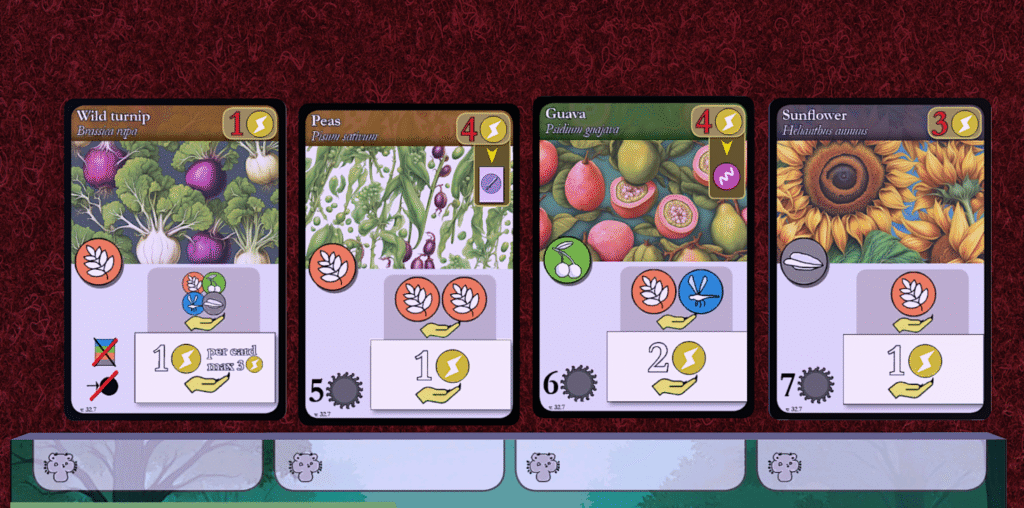
The Food cards themselves are now the primary way to increase energy production. This is done by combining specific types of Food together.


Added and removed components
+territory tiles
-territory energy dice
-base energy tile
Change #4 – New Fight System
I really liked the feel of the custom energy dice and the tetrahedron strength dice. However, with the new direction towards a more puzzly euro game the energy dice had no place in the game anymore. In addition, the strength dice slots on the Items are removed (more about that later). This led me to try out a new fighting system without dice altogether.
The new system uses hidden strength values on cards to create tension, instead of the dice. The new fight cards can replace both the strength dice and the sword resource. You can have up to five fight cards on hand and you are allowed to play one card per fight. Some cards allow you to gain a big boost to the strength by using Protein or by discarding fight cards. This allows you to go really hard to win a crucial fight. But it will leave you weaker for the next fight.
Each Item increases you base Strength by one.

Added and removed components
+fighting cards
-strength dice
-weapons resource (track and marker)
Change #5 – New Items (As Many As You Can Get!) That Encourage Specialization
I have removed the max cap of two Items. Now you can have as many as you can get. You still need to have a specific Food type for each Item. But you no longer need to trash the Food. It’s enough to have the specific Food type in your Pouch. This should speed up the speed of the game quite a bit, since you are not hurting your energy generation when you gain an Item. Also, the Items now give continuous effects that will make various actions cheaper. This further speed up the game and also makes it possible to specialize in different parts of the game. For example, by gathering Items that rewards gaining Fight cards, recipes or Territory tiles.
The end-game scoring conditions on the old Items have been moved to the recipes instead.
Added and removed components
-lotus seed cards
Change #6 – Bigger Burrow, More Choices For Materials
This is an important change that will allow players to really get rewarded for building a great energy generation engine. Now you can have as many Food cards as you can get into your Burrow, when it is fully built out.

Change #7 – New Special Abilities
This is a small change, compared to the other changes. Before, you could get an extra action tile when you performed your special ability. This extra action is now provided by the extra action cards that are distributed to the players after the first season. Instead, I added a unique weapon token for each special ability. This token is removed to indicate that you have used the special ability. The token is placed for example in a territory or on an opponent’s Food and provides an on-going effect there.


Added and removed components
+weapon token
-extra action tile
Leave a Reply